The Little Boat Beside Her: Picking a Tender That Earns Its Keep
There is a revealing moment at any classic boat mooring: the mothership sits beautifully on her lines, brightwork gleaming, and then astern there bobs a grey rubber bag with a outboard clamped to a bit of plywood. The tender has been treated as an afterthought. It is understandable. The yacht takes the love, the time and the money. But the dinghy is the boat you actually use most often. It is the boat that takes you ashore for milk, ferries the crew, carries the dog and brings the grandchildren out for a wobble around the harbour. It deserves a little thought.
A good tender should not compete with the classic yacht. It should complement her. That does not mean it has to be a varnished museum piece, but it does mean it should look as if someone thought about the pairing. The right little boat makes the whole arrangement feel complete. The wrong one makes every trip ashore a small negotiation with gravity, tide and wet feet.
Start with the job, not the brochure
Before looking at anything, be honest about what the tender is for. If the yacht lives on a swinging mooring in Chichester Harbour and the main run is two adults, a shopping bag and perhaps a reluctant terrier, a stable pram dinghy or a small inflatable will do nicely. If you anchor off Cornish beaches and need to row a fair distance with four people and a picnic, a proper rowing boat earns its place. If the dinghy must live on the cabin top or be dragged up a steep slipway singlehanded, weight becomes the dominant question.
It is worth writing down the real payload: people, outboard, fuel, oars, anchor, shopping, wet weather gear. Then add a margin. Dinghies are like tents. The stated capacity is often optimistic once everyone is wearing boots.
The humble GRP pram has a lot to answer for
A moulded GRP pram is not romantic. It will never make anyone sigh at the yard. But it is stable, tough, simple to repair and usually cheap. It rows well enough for short hops, takes a small outboard, and can be left on a muddy foreshore without a crisis. For many classic owners, especially those with moorings reached by a club slipway, a pram is the sensible answer. A coat of paint in a colour taken from the yacht’s boot-top or cove line can make a surprising difference. Add a neat cover and decent fenders and it stops looking like a plastic tub and starts looking like part of the crew.
Clinker, character and the weight penalty
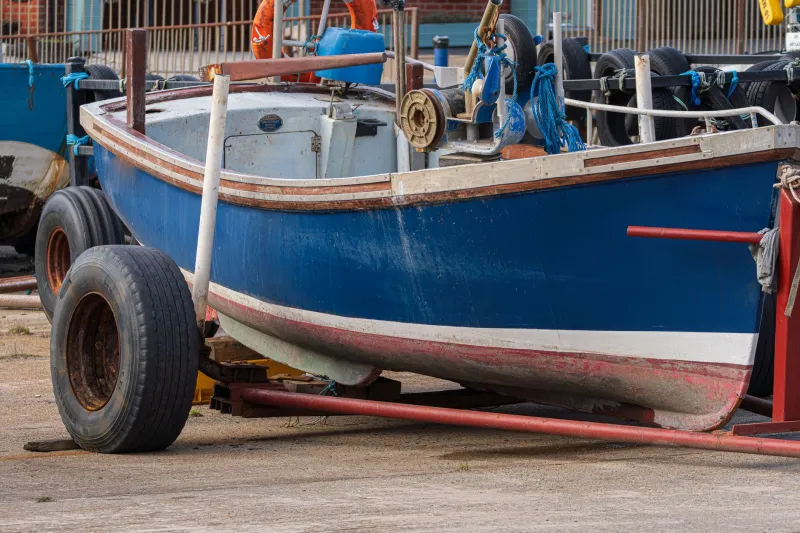
A clinker rowing boat is the tender many of us would choose if stowage and strength were unlimited. She looks right beside a wooden yacht. She rows sweetly, carries a load and has a shape that seems to belong on the water. But she is heavy, she needs looking after, and she can be awkward to lift onto a cabin top or drag up a gravel slip. If you go down this route, be realistic about maintenance. A clinker dinghy left upside down on a mooring all summer will soon show it. That is not a reason to avoid one, but it is a reason to buy with your eyes open and to budget for paint, varnish and the occasional plank.
Folders, inflatables and the stowage bargain
Folding dinghies are clever things, particularly for owners who need to stow a tender below or in a cockpit locker. They are not everyone’s idea of a classic accessory, but they work. Inflatables are similarly practical: stable, forgiving and easy to pack away. The key is to buy a good one rather than the cheapest thing at a boat jumble. Check the valves, the seams and the age of the fabric. PVC is fine for occasional use, but Hypalon tends to last better in strong sun. A patch kit and a pump are part of the purchase, not an optional extra.
Davits, decks and the singlehanded launch
This is where many otherwise sensible plans fall apart. A tender that is perfect on paper can be miserable if it is too heavy for the davits, too long for the foredeck or too awkward to launch alone. Check the safe working load of the davits, not just the breaking strain. Think about the outboard: a four-stroke that feels manageable in the shed can become a different proposition while balancing on a pontoon. If you regularly sail singlehanded, practise the whole routine before the season starts. Better still, buy the smallest and lightest tender that will genuinely do the job.
UK slipways add their own drama. Steep concrete, green weed, a tide that leaves the trolley stranded and a queue of people waiting are all part of the experience. A tender with a decent painter, a reliable drain plug and a set of oars that actually fit is worth more than a fancy specification. A small trolley or a set of launching wheels can transform a heavy dinghy, but only if you have somewhere to stow them.
Buying used without buying trouble
Secondhand tenders are plentiful and often good value, but they are also a refuge for the tired and the leaky. Look carefully at the hull or fabric, the transom, the rowlocks and the buoyancy arrangements. If it is GRP, check for cracks and repairs around the keel and transom. If it is wooden, look for rot in the garboards and around the stem. If it is inflatable, inflate it properly and leave it for a day. Ask why it is being sold. A free dinghy is rarely free once you have bought oars, a pump, a cover and a outboard bracket.
The quiet pleasure of a matched pair
A well-chosen tender does not need to be grand. It needs to be safe, light enough to handle and pleasant enough to use. Paint it properly, keep the oars aboard, stow a bailer and a spare painter, and give it a name if the mood takes you. The reward is not just convenience. It is the sight of a small, capable boat lying alongside a classic yacht, looking as though she belongs there. That is the tender doing its quiet work: making the whole day afloat feel complete.