A Galley No Bigger Than a Tea Chest: Cooking That Belongs to the Boat
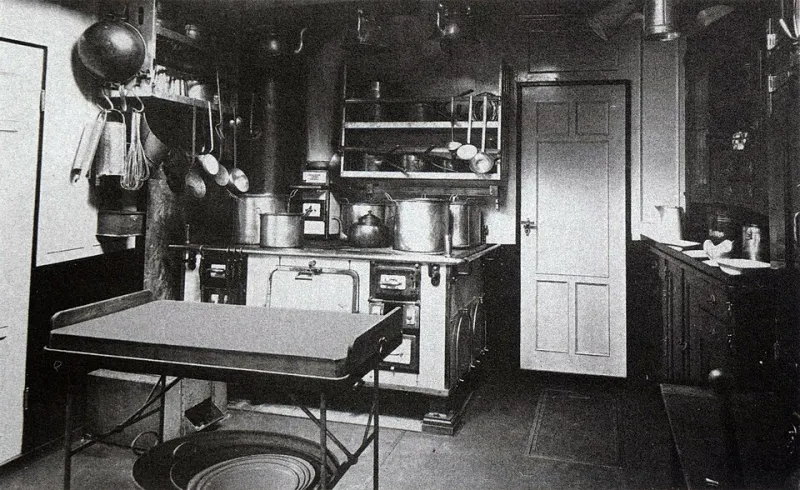
Photo: Sir James, Public domain, via Wikimedia Commons
There is a particular smell that belongs to a classic boat at anchor: warm paraffin, damp varnish, strong tea and, if you are lucky, toast that has gone slightly too far. The galley that produces it is rarely impressive. It is a strip of worktop, a couple of rings, a locker full of mismatched mugs and a kettle that swings on gimbals like a small brass pendulum. Yet on a grey Saturday in Falmouth, or tucked into a quiet creek off the Walton Backwaters, that narrow little workshop can feel more like home than any shoreside kitchen.
Cooking aboard is not camping with better joinery. It is domesticity scaled down until every action matters: where the matches live, which locker holds the tea, how to drain pasta without wearing it. The boat sets the terms. The cook learns to work within them.
The Stove Has a Personality
Not all galley stoves are equal, and none of them are invisible. A spirit stove, burning methylated spirits in a non-pressurised canister, is the quiet traditionalist of the cabin. It lights with a soft blue ring, heats a kettle without drama and demands little more than a steady hand and a supply of fuel. A paraffin stove is altogether more theatrical: prime the burner, wait for the flame to settle, listen for the roar. Get it wrong and you will know about it. Get it right and it will boil a pan in a way that feels almost civilised.
Gas is convenient, but it deserves respect. A classic boat with a gas installation should have a proper locker, a bubble test with soapy water rather than a lighter, and a carbon monoxide alarm that is tested as routinely as the bilge pump. Whatever the fuel, the rules are similar: never leave a live flame unattended, keep tea towels and curtains well clear, and know where the fire blanket lives before you need it. A galley fire is not the moment to start looking behind the chart table.
Ventilation Is the First Ingredient
Every flame consumes air. In a small cabin, with the hatch dogged down against drizzle, that fact matters. Crack a hatch, open a dorade, use the extractor if you have one, and never assume the boat is ventilated simply because it feels draughty when you are sitting in it. Carbon monoxide is colourless, and a spirit or gas stove in a sealed cabin is not a risk worth taking for the sake of a dry curtain.
The practical compromise is to cook with the windward hatch lifted a few inches and a towel ready for the spray. On wet days, cook earlier, cook faster and keep the cabin as airy as the weather allows. It is not a hardship. A well-ventilated galley smells of supper, not of regret.
Provisions With a Short Horizon
A weekend afloat is not an Atlantic crossing. The temptation to provision as though for a month is strong, especially in a chandlery with a good deli counter. Resist it. Buy fresh where you are: a butcher in Falmouth, a bakery near Chichester, a farm shop on the way to the Broads. Then build a small, reliable store around it: eggs, onions, potatoes, carrots, tinned tomatoes, chickpeas, dried pasta, stock cubes, a jar of mustard, marmalade, UHT milk and a decent curry powder.
Store in latched lockers, not open shelves. Decant flour and rice into square containers that stack. Keep glass to a minimum, and what glass you do carry should live low and wedged. Label the date on anything opened. A classic boat has enough patina without adding a mystery jar from two seasons ago.
One Pot, Two Rings
The best galley cooking is wide, shallow and forgiving. A heavy-based pan with a lid will do more than a cupboard full of gadgets. So will a small pressure cooker, if you have the confidence, or a thermal cooker that finishes the job while you are on deck.
A useful supper: soften an onion and a sliced chorizo in the pan, add a tin of chickpeas, a tin of tomatoes, a spoon of smoked paprika and a splash of water. Let it bubble until it thickens. Eat it with bread, or rice cooked on the other ring. Another: smoked mackerel flaked through hot pasta with peas, lemon and black pepper. Porridge in the morning, made slowly with a pinch of salt, is a galley ritual in itself. Toast can be done in a dry pan, turned once, watched closely. It will never be even. That is part of its charm.
The Ritual of the Kettle
The first job of the day is the kettle. Before the chart, before the weather, before the argument about whose turn it is to pump the heads. The gimballed kettle swings as the boat moves, and the water inside stays more or less where it should. Fill it only as much as you need. Light the stove, wait for the blue ring, and listen. That small roar is the sound of the day beginning.
Washing up is part of the same ritual. A basin, a little washing-up liquid, a kettle of hot water, a rinse in fresh. Salt water first if you are being careful with supplies, then a quick fresh rinse and a dry on the rail. Stow as you go. A galley that is put away after every meal is a galley that stays usable in a seaway.
Cooking When the Boat Is Moving
Passage-making changes the menu. Boiling water is a hazard; sharp knives are a hazard; a pan that slides is a hazard. Cook at anchor or on a sheltered tack if you can. If you cannot, use a flask, sandwiches, fruit, soup, and the kind of food that does not need a flame. A thermos of hot water is a small galley in itself: tea, instant coffee, couscous, even a pot noodle if standards have slipped. Keep the kettle secured, the pan on the lowest ring, and the cook braced with one hip against the chart table.
A Galley That Earns Its Keep
The finest galley is not the largest or the most modern. It is the one where you know, without looking, which locker holds the matches, which mug is yours and how long the kettle takes to sing. It is the one that turns a damp anchorage into a place you are glad to be. A classic boat does not need a restaurant below. It needs a blue flame, a swinging kettle and someone willing to eat burnt toast with a view of the water. That is a floating kitchen, and it is enough.