The Locker Tells First: Reading Old Ground Tackle Before You Buy
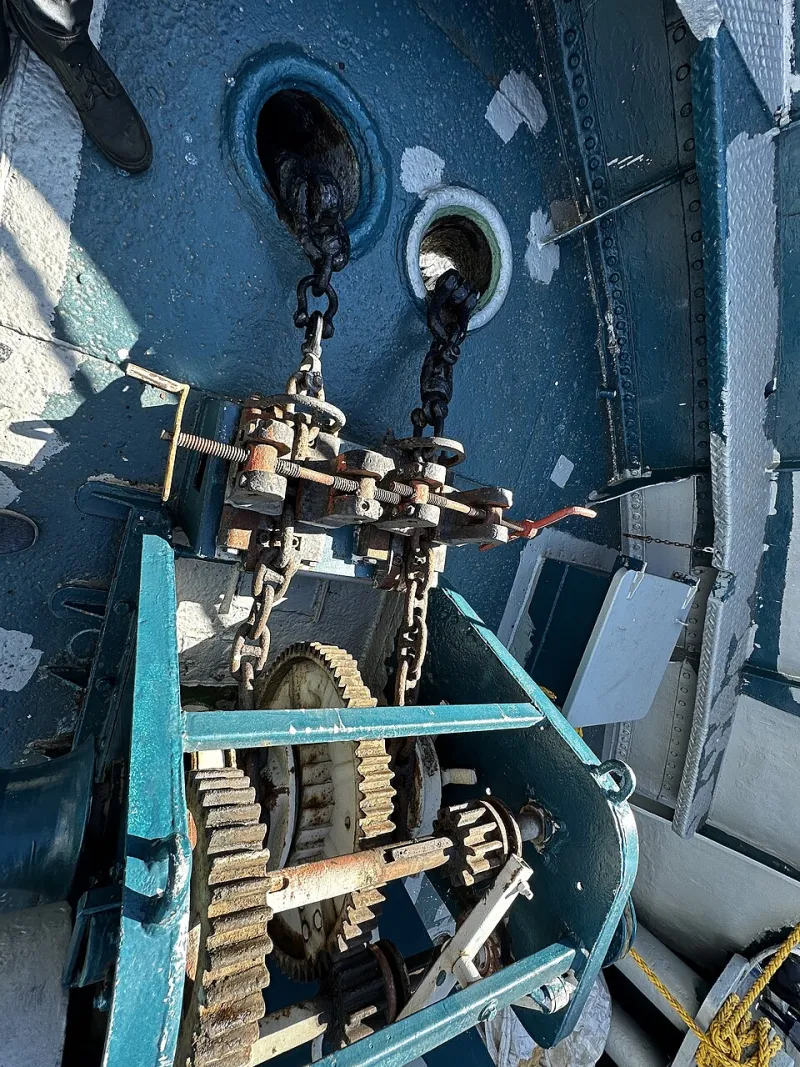
Photo: Matt Brown, CC BY 4.0, via Wikimedia Commons
Every classic boat has a compartment it would rather you did not open first. Usually it is the anchor locker: a damp, dark cupboard under the foredeck, half-full of chain, old rope and the accumulated grit of several decades. It is also one of the most honest places on board. Long after the brochure photographs have faded and the varnish has been refreshed for sale, the ground tackle is still sitting there, quietly telling you where the boat has been and how she was kept.
The locker opens on a smell
Open the hatch and wait a moment. The smell is part of the evidence: cold mud, old galvanising, wet rope, perhaps a ghost of diesel or a trace of harbour weed. Take a torch, a pair of gloves and a notebook. Resist the urge to drag everything out onto the pontoon in one heap. Lift the chain clear in sections, photograph what you find, and keep a rough note of the order in which it came out. A locker is easier to read when you have not turned it into a lucky dip.
Chain keeps a rough log
Anchor chain is a diary written in links. Look at the galvanising, or what remains of it. A chain that is bright and smooth has probably led an easy life; one that is dull, pitted and stiff with rust has spent more time down a muddy creek than on a display stand. Check the ends first. Chain wears hardest where it runs over the bow roller and through the windlass, so a length that has been end-for-ended may show two tired ends and a healthier middle. That is not necessarily a bad sign. It is simply a previous owner trying to be sensible.
Look for elongated links, stiff joints, deep pitting and any sign that the chain has been joined with mismatched shackles. Old chain can be perfectly sound, but it can also be well past its working life. A stamp on the chain or a maker's mark on a shackle is worth recording, but do not treat it as a guarantee. For anything you intend to trust at anchor, have the gear inspected or replace it. The locker may be an archive; the seabed is not an exhibition.
Warps, splices and the ghost of a mooring
Rope is more personal than chain. A neat splice with a proper whipping speaks of a careful hand and a winter evening well spent. A melted rope end and a knot that has been tightened until it has gone shiny speaks of hurry. Three-strand nylon, hard eyes, tarred hemp, a length of floating line that has clearly been used as a pick-up buoy warp: each one is a small clue to how the boat was moored and where.
Spliced warps also tell you about size. If the locker contains mooring lines fit for a boat half as long again, ask why. Perhaps the previous owner kept her on a exposed mooring, or perhaps the gear simply migrated from an earlier boat. Either way, it is a prompt for a question, not a verdict.
Shackles: the mismatched family
Few lockers contain a tidy set of identical shackles. Most contain a family reunion: a galvanised bow shackle, a stainless twist shackle, a small bronze one with a chandlery stamp, and a collection of split pins and mousing wire that suggests someone once took the job seriously. Mixed metals can encourage corrosion, and a shackle with a worn pin or a distorted bow is not a bargain. But old stamps are lovely things. A faded maker's name from a Falmouth chandler, a Liverpool supplier or a small yard on the East Coast can be a genuine trace of the boat's travels. Photograph it, record it, and then decide whether it belongs in the working kit or in a box of curiosities.
Mud is a map, but a smudged one
Perhaps the most evocative evidence is the mud. Black, oily silt from an East Coast harbour smells quite different from the pale sand of a Morecambe Bay drying berth or the red-brown silt of the Bristol Channel. A crust of it in the chain locker can hint at cruising grounds and winter moorings, especially if the boat has stayed in one region for years. Treat it as a hint rather than a chart. Mud travels, and a boat can pick up a surprising amount of another harbour's bottom in a single season.
A buyer's checklist for the locker
Before you fall for the romance of it all, check the practical things. Is the drain clear? Does water sit in the bottom of the locker? Is there ventilation, or is the space permanently damp? Is the bitter end of the chain properly secured to a strong point, or is it simply lost in the murk? Can you reach the chain safely, and does it fall freely when you need it to? A locker full of water is not a time capsule; it is a problem looking for a surveyor.
Then ask what you would actually use. Old chain can be kept for display, for patterns or for a mooring riser if it is genuinely sound, but your anchoring gear should be gear you can trust. The same goes for shackles and warps. Nostalgia is a fine crew member, but a poor anchor.
Keep the archive, replace the working kit
The best approach is to separate the two. Keep the stamped shackle, the beautifully spliced warp and the chain with a story, but do not let them carry the load simply because they came with the boat. Replace the working ground tackle, keep the old pieces as provenance, and leave a note in the locker for the next owner. It is a small kindness, and it keeps the diary going.
A classic boat is often described as a collection of previous owners' decisions. The anchor locker is where those decisions are least polished and most visible. Open it slowly, read it carefully, and you will learn more about the boat than any polished brass fitting can tell you.