The Counter Is the Catalogue: Six Chandlers Worth a Classic Boat Detour
Classic boating likes to pretend it is about boats. It isn't. It is about the people who keep the odd little bits of them alive. The right bronze cleat. A length of tarred hemp. A pot of varnish that hasn't been reformulated into something sensible. And in 2026, the best place to find all three is still a chandlery counter with a bell over the door.
Online catalogues are marvellous if you know the part number. Classic boats are mostly a collection of unknown part numbers. That is why the old-school chandler matters. Not because the website is charmingly absent, but because the person behind the counter has spent thirty years learning what a worn fitting looks like before it fails. They are not retail assistants. They are diagnosticians with a card machine.
Why a counter beats a catalogue
A good chandlery counter works like a surgery. You arrive with a complaint. The counter hand asks three questions, disappears into a back room, and returns with a box of bronze fittings that looks like it was last opened during the Falklands. Somewhere in it is the thing you need. It may not be new. It may not be in a bag. It will fit.
That knowledge is not quaint. It is infrastructure. Boatyards get the glory, but chandlers keep the boats moving between yard visits. They stock the awkward screws, the imperial threads, the tinned wire, the galvanised shackles, and the little brass hinges that no one makes any more. They also keep the handwritten stock card, a quietly radical technology that tells you what is in drawer seven without asking a server in another country.
What follows is a coastal tour of six counters that still do it the old way. Some are salty. Some are tidy. All of them are worth a detour, and not just because you forgot a impeller.
Trelawney's Counter, Fowey
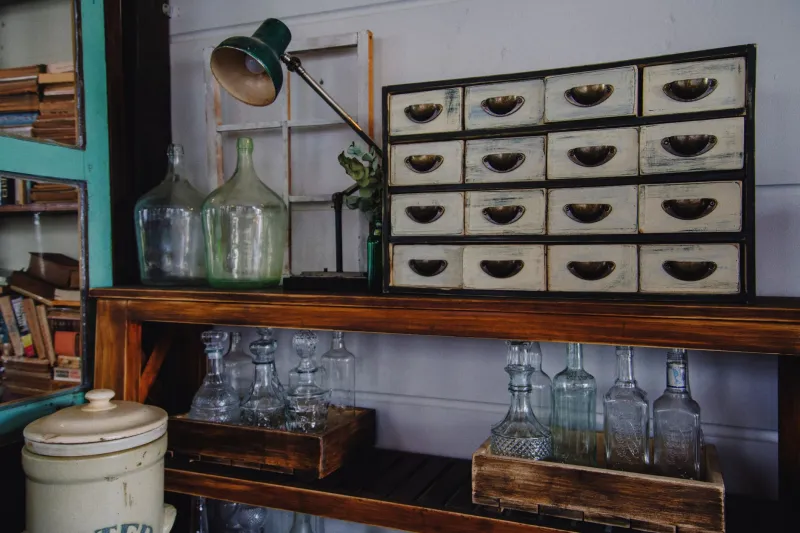
A bell, a narrow aisle, and a wall of mahogany drawers labelled in copperplate. Trelawney's smells of tarred hemp and old rope, with a top note of paraffin. The owner, Ewan, keeps a tray of retired bronze cleats under the counter and can usually match an obsolete pattern by eye if you bring the old one in a jam jar. He is polite about it, but you can tell he enjoys the puzzle. Cash is welcome. Advice is free. The tea is strong enough to strip varnish.
The Rope Walk, Woodbridge
Ruth's shop is half chandlery, half splicing bench. Coils of tarred hemp hang from the ceiling like dark liquorice, and the stock cards are written in pencil because ink smudges when the kettle goes on. She sells rope by the metre and will tell you, gently, if your halyard is too stiff for a 1960s folkboat. The drawers here are not labelled bronze and brass. They are labelled small, smaller, and ask Ruth.
Harbour Stores, Aberaeron
Dafydd's counter faces a wall of galvanised fittings, brass screws, and drawers that stick in damp weather. There is no website. There is a ledger. The handwritten stock cards are arranged by boat rather than by part, which sounds chaotic until you realise it is how everyone actually thinks. If you need a bronze hinge for a cockpit locker on a 1970s cruiser, Dafydd will squint, disappear, and return with two. One will fit. The other will be a spare, because he knows you will lose it.
Coble & Co., Amble
Janet's shop sits close enough to the harbour that you can smell the tide when the door opens. The stock leans towards working boats and old fishing cobles, but the drawers hide bronze cleats, galvanised eyes, and odd little fittings that look like they belong in a museum. Janet does not do hard sells. She does hard questions. What is the boat? What is the mooring? Is it salt or fresh? By the time you leave, you have the part and a short lecture on why you should not overtighten it.
The Ironmonger's Daughter, Oban
Fiona's counter is a marriage of chandlery and ironmongery, which means you can buy bronze wood screws, a brass cabin hook, and a decent tin opener in one trip. The shop smells of linseed oil and paraffin, and the handwritten stock cards are kept in a wooden box that looks older than the boats outside. Fiona is the person to ask about varnish, brass polish, and why your cabin sole is squeaking. She will not pretend to know everything. She will know someone who does.
Slack Tide Supplies, Dartmouth
Peter's counter is a masterclass in controlled clutter. Brass fittings in shallow drawers. Varnish by the tin. A tea mug that has seen better decades. He keeps a boat jumble corner at the back, which is really a holding pen for parts that have not yet found their boat. The stock cards are handwritten and occasionally crossed out, which is exactly what you want from a chandlery. It means someone has been counting.
Use them or lose them
None of these shops are museums. They are working counters, and they survive because people use them. That means bringing in the old part, buying the odd screw, asking the daft question, and paying for the tea if there is a tin. It means recognising that a chandler is not a quaint alternative to an online basket. It is a link in the chain that keeps classic boats afloat.
In 2026, the fancy catalogues will still be there. So, with luck, will the bell over the door. Go while the drawers still open.